FIELD NOTES / ENGINEERING
AI is compressing the engineering loop.
The largest gains appear when a task is digital, testable, and repeatable. The closer work gets to factories, field conditions, certification, and human judgment, the smaller the total-program gain becomes.
01 / THE PATTERN
The speedup is not in “engineering.” It is inside specific loops.
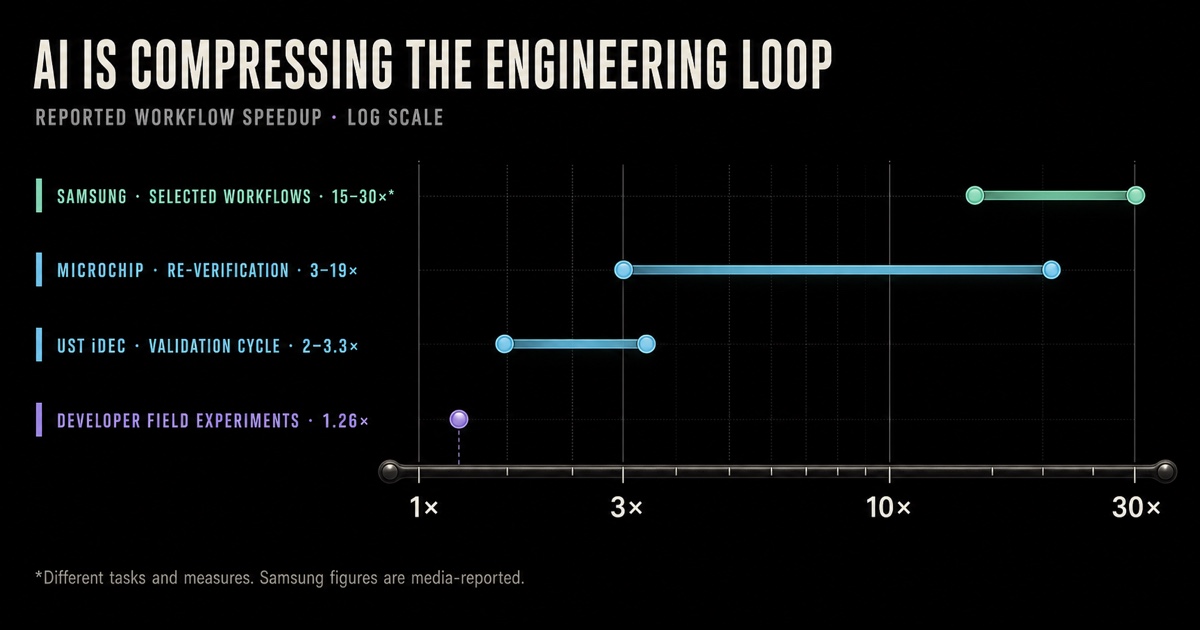
A Samsung semiconductor report makes the change easy to see. According to ChosunBiz, a customer-specific system-on-chip verification workflow fell from more than one month to two days. A USB-related development model reportedly fell from more than one month to one day.
Those are roughly 15× and 30× calendar-time improvements. The direction is credible. Samsung's wider deployment of Claude, ChatGPT, and Gemini is independently reported. The exact multiples are only moderately verified because the tasks, quality checks, human hours, and later rework have not been published.
The more durable finding is the mechanism. AI can write scripts, operate existing engineering tools, run simulations, inspect results, repair failures, and repeat. It does not have to replace the whole engineer to make one expensive feedback loop move much faster.
02 / THE EVIDENCE LADDER
The strongest numbers measure different things.
A selected verification run, a validation platform, code volume, and organization-wide task completion are not interchangeable. Each answers a different question.
Bounded loops can move much faster than whole organizations.
-
Samsung selected workflows15–30×Media report · moderate verification
-
Microchip re-verification3–19×Customer and vendor case · selected circuits
-
UST iDEC validation cycle2–3.3×Existing platform result · Claude integration follows
-
Developer field experiments1.26×Randomized trials · 4,867 developers
Lower serving cost
OpenAI reports that GPT-5.6 Sol rewrote production GPU kernels inside a verified human-led process. Combined kernel work reduced end-to-end serving cost by 20%.
OpenAI engineering report ↗More code per engineer
Anthropic reports 8× more merged code per engineer per day than in 2024, while warning that lines of code almost certainly overstate the true productivity gain.
Anthropic Institute report ↗More completed tasks
Three randomized field experiments found 26.08% more completed tasks across 4,867 software developers. This is less dramatic and more representative.
Management Science paper ↗03 / WHY IT WORKS
AI accelerates engineering when the feedback loop can close.
- 01
Read the system
Code, schematics, logs, requirements, simulation inputs, and prior runs are available in machine-readable form.
- 02
Propose a change
The agent writes code, tests, models, scripts, or design variants inside stated constraints.
- 03
Run the tool
Compilers, simulators, regression suites, digital twins, or laboratory controls produce a result.
- 04
Judge the result
A clear pass/fail rule, score, or measured error gives the system useful feedback.
- 05
Repeat cheaply
The loop runs again without waiting for a new prototype, permit, supplier, test site, or committee.
04 / ACROSS ENGINEERING
The pattern travels. The constraints change.
The same agent can help in many domains, but the share of work that is digital and cheaply verifiable varies sharply.
| Domain | Where acceleration is strongest | What still sets the pace | Evidence now |
|---|---|---|---|
| Semiconductors and EDA | Test generation, verification scripts, simulation, regression, log analysis | Physical validation, tape-out, manufacturing yield | Strong |
| Software and controls | Implementation, tests, debugging, migrations, documentation | Architecture, security, integration, product judgment | Strong |
| Mechanical and aerospace | Generative design, topology search, simulation, design-space exploration | Prototypes, durability, manufacturing, certification | Strong digitally |
| Materials and chemical | Candidate screening, experiment selection, autonomous laboratory loops | Scale-up, reproducibility, safety, mass production | Strong in discovery |
| Civil and construction | Takeoffs, drafting, clash detection, schedules, alternatives | Permits, sites, labor, supply chains, professional sign-off | Moderate |
| Nuclear, medical, regulated | Analysis, simulation, documentation, test generation | Validation, traceability, regulation, accountable approval | Useful, constrained |
Hours to generate, about a week to prototype
NASA reports that evolved structures can be generated in one or two hours, save up to two-thirds of component weight, and reach a prototype in about one week. Human review and NASA-standard validation remain required.
NASA case ↗More of the design space explored
A peer-reviewed agentic design study measured 11.4% more design-space coverage and 18.5% more diversity during early exploration. This is a design-quality result, not a complete program speedup.
Nature Communications ↗About 10× fewer phase-mapping experiments
NIST reports that autonomous phase mapping reduced the measurement experiments needed by an order of magnitude. The closed loop combines physical measurements, uncertainty, and expert guidance.
NIST program ↗05 / THE BOTTLENECK MOVES
When generation gets cheap, judgment becomes the scarce layer.
More code, models, tests, and design variants do not automatically create more value. They can also create more review, more integration work, and more ways for a plausible error to travel downstream.
Anthropic's own report shows the distinction. More than 80% of merged code was attributed to Claude by May 2026, but the company explicitly says its 8× code-volume measure overstates productivity. Humans still decide which problems matter, which tradeoffs are acceptable, and whether the result is safe enough to ship.
OpenAI's kernel result shows the productive form of the same pattern. The agent worked inside a human-led system with production traffic, correctness tooling, and whole-system cost measurements. The value came from the complete loop, not code generation alone.
- problem selection
- constraints
- verification
- integration
- accountability
06 / HOW TO MEASURE IT
Count accepted outcomes, not generated artifacts.
The right measurement protects a team from both hype and hidden rework.
- 01
Calendar time to an accepted result
Measure from a real request to a reviewed, usable output. Do not stop the clock at first draft.
- 02
Human hours and intervention
Record setup, supervision, rescue, review, and rework. A fast machine run can still consume expert time.
- 03
Quality and defect escape
Use the same verification standard for AI-assisted and baseline work. Track failures that appear later.
- 04
Throughput at the team boundary
Measure completed tasks, verified designs, resolved incidents, or released changes, not tokens or lines of code.
- 05
Whole-program lead time
Check whether the faster digital loop changes prototype, certification, manufacturing, construction, or deployment dates.
- 06
New work made economical
Include valuable experiments, cleanup, verification, and alternatives that were previously too expensive to attempt.
THE BOTTOM LINE
AI does not have to replace the engineer to transform engineering.
It only has to compress enough of the read, change, simulate, test, and repeat cycle. That is already happening in software, semiconductor verification, digital design, and selected scientific laboratories.
The spectacular figures belong to bounded workflows with fast feedback. Broader field evidence points to smaller but still important gains. Physical work, regulation, integration, and accountable judgment remain decisive.
The practical opportunity is therefore precise: find the loop that is digital enough to run, measurable enough to judge, and valuable enough to repeat. Then keep a human responsible for the goal and the final consequence.
07 / SOURCE NOTES
What supports the claims.
Company case studies establish what the named organization reported. They are not independent audits. Peer-reviewed field experiments and public research programs receive more weight for broader claims.
- ChosunBiz: Samsung System LSI internal Claude Code casesAug 12, 2026 · media report · moderate verification
- Korea Times: Samsung's broader AI rolloutJun 11, 2026 · independent reporting
- Siemens and Microchip: accelerated circuit re-verificationMay 8, 2026 · vendor and customer case
- Anthropic and UST: Claude in physical-AI engineering systemsJul 9, 2026 · partnership case
- OpenAI: GPT-5.6 Sol production engineering and inference efficiencyJul 29, 2026 · first-party engineering report
- Anthropic Institute: internal engineering acceleration2026 · first-party internal data with explicit caveats
- Management Science: three randomized developer field experimentsFeb 27, 2026 · peer reviewed · 4,867 developers
- NASA: evolved spacecraft structuresOfficial program case · human validation retained
- Nature Communications: agentic conceptual engineering designJan 24, 2026 · peer reviewed
- NIST: autonomous materials research and metrologyOfficial ongoing program · updated Sep 2025
Evidence cutoff: August 12, 2026. This field note explains technology and workflow evidence. It does not promise that any organization will reproduce the reported gains.