
FIELD NOTE · TOOLS, TRACES AND THE LIMITS OF REACH
The Reach
of Being
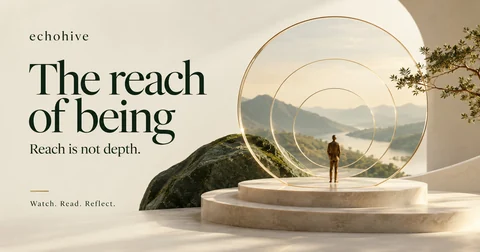
Your body stays the same size. Glasses, tools, marks, virtual worlds and now AI let more of you take form beyond it. That reach is real. It is not the same as depth.
The Reach of Being
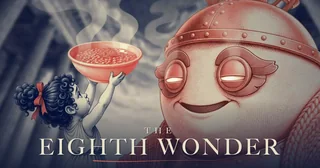
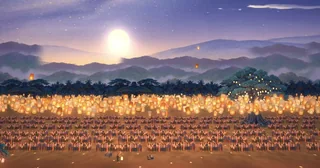
A narration-only film that travels from a hand stencil at least 67,800 years old to a 2025 model that turned text prompts into worlds you could move through. Made with Opus 5.5 and narrated with the creator’s approved synthesized voice. The pictures are original code-drawn illustrations, not archival images or AI model footage. The companion below adds the caveats a film has no time for.
CHOOSE A MOMENT · TAP TO WATCH
We already live a little beyond our skin.
We choose glasses, borrow a gesture from someone we admire, arrange a room until it feels like ours. Something inward takes an outward form, and then we live inside it.
Spectacles show how quickly a tool becomes part of a self. In a Florence sermon from early 1306 by modern reckoning, the friar Giordano da Pisa said the art of making them was not yet twenty years old. They began as a way to see. At a mirror today, the question is also: is this me?
“In time, we begin to inhabit what we have made.”
Research: the 1306 sermonReflection: living inside what we make
Every reach comes with a limit.
Tools are older than we are: flaked stones from Lomekwi 3, in northern Kenya, are about 3.3 million years old, far older than our species. Here are four later stops from the film, each paired with what the evidence does not say.
How claims are markedResearchReflectionSpeculationImagined
A hand that left, an outline that stayed
Someone pressed a hand to the rock and sprayed pigment around it. The outline stayed. Later, its fingers were deliberately narrowed into a claw-like shape. What that meant remains open.
The date is a minimum, not a moment of creation. Calcite that formed over the stencil dates to about 71,600 years, give or take 3,800, so the stencil is at least 67,800 years old. Its maker is unknown. A trace keeps the outline of a hand, not the life behind it.
ResearchReflection: the last line
▶ Watch 0:52A tool can enter the body’s map
After macaques learned to rake in objects out of reach, neurons that responded to touch on the hand and to sights near it began responding along the rake. After people used a mechanical grabber, their free-hand movements and localization of touches changed, consistent with a longer represented arm.
These are changes in how the brain represents the body for a task, not physical growth. The monkey recordings came during tool use and the human measures after it; this note makes no claim about how long the effect lasts. Neither study is evidence about AI minds.
Research, historical studies
▶ Watch 1:32A mark that answers for the work
From 1363, English goldsmiths had to strike a mark of their own on their wares. An object could now carry its maker into rooms the maker would never enter.
The rule required a mark that identified the maker. Reading it as “and answers for it” is the film’s interpretation. It is also the useful part: the further work travels without us, the more it needs a name that can be found.
ResearchReflection: answerability
▶ Watch 2:29A game world that stepped off the screen
Refugees and host community members learned design skills in Minecraft in workshops with UN-Habitat and the Block by Block Foundation, then planned shared public spaces. The plan provided for shade, solar lighting and more than 500 trees. Women had major roles in building the space and planting.
Software did not build the place. People did, with partners including UNHCR, the Turkana County Government and AAR Japan. In December 2018, UN-Habitat reported one of four spaces and a transport hub built, with the other three due to start in 2019.
Research
▶ Watch 3:20Each time, intention travels further from the body. Each time, someone still has to choose it, build it, sign it and look after it.
What was possible in 2025, and what it does not prove.
The film suggests AI may widen this radius, perhaps exponentially: an idea becoming a working system, an imagined place becoming somewhere others can enter. That part is speculation. Two dated results give it texture, not proof.
Speculation: “perhaps exponentially”
Longer tasks, on a human clock
METR measured a software task’s length by how long it takes a human professional. The length of tasks frontier AI agents could complete about half the time had doubled roughly every seven months over the previous six years. The report put Claude 3.7 Sonnet at about an hour.
Not a forecast, and not a measure of today’s systems, their speed or their intelligence. The authors name real-world transfer among their main uncertainties.
A world from a text prompt
Genie 3 generated environments from text that a user could move through in real time, at 24 frames per second and 720p, staying consistent for a few minutes.
A limited research preview, with a limited action space, short interactions and imperfect real-world accuracy. The harbor in the film is a drawing, not model footage.
The film pictures a teacher describing a tide pool to an AI system, then shaping it with students into a small world they can explore: tap a crab, raise the tide, see what survives. Contrast it with Kalobeyei, which really happened and was built by people on the ground.
Two boundaries keep this honest. A doubling trend on particular tasks is not a law of nature. And the body-map research above concerns rakes and grabbers. It does not show that AI systems have minds, or that software becomes part of your body.
Reflection: the boundaries
A faster tool does not make a wiser hand.
Making more is not the same as meaning more. As ideas become working systems more easily, the scarce part shifts away from making and toward the crafts the film calls old:
- Choose what deserves to exist.Ten generated options are not ten decisions. With abundance, selection becomes the skill.
- Mark what you made.A modern maker’s mark can be a plain note: who made this, with which tools, and what was checked.
- Answer for it.What others meet is a partial shape of you, and it can help or harm them. Stay findable when it does.
- Maintain it.A world others can enter needs someone who keeps it working after the excitement fades, and who retires it with care.
Reflection: the film’s argument, not a finding
Four questions before you extend yourself.
Use this before you hand a task to an agent, publish a tool, or open a space to other people. There is no score. The value is in writing honest answers somewhere you will see them again.
Imagined exampleAn agent that drafts replies to customer emails.
-
Which part of my intention, effort or presence should travel further?
ExampleFast, consistent first drafts, so people hear back sooner.
-
What stays in my own hands, voice or attention?
ExampleRefunds, apologies, and anything that turns on a relationship.
-
Who meets this when I am not there, and who inherits it later?
ExampleA customer who gets a confident wrong answer. Whoever maintains the agent next year.
-
What will I check, and how often, after the excitement fades?
ExampleRead a sample of sent replies every Friday. Review everything it escalates.
YOUR NOTE
This worksheet does not save or send what you type.
If your honest answer to question three is “many people,” it may be worth stepping back to the larger system before choosing the next tool. Private consulting helps clarify that system, where attention belongs, and where your next move has leverage ↗
Sources, marks and boundaries.
This is a reading companion to the film, not its transcript. Research claims follow the sources below. Studies carry their dates; the 2025 AI results are historical, not forecasts or descriptions of current systems.
Open the 11 sources
- Oktaviana et al., “Rock art from at least 67,800 years ago in Sulawesi”. Nature, published online January 21, 2026. Minimum age from uranium-series dating of calcite over the stencil.
- Southern Cross University news release, January 22, 2026. The deliberately narrowed fingers; meaning left open.
- Baldanzi and Farini, “Florence and the history of glasses”. Il Colle di Galileo, 2024. Quotes Giordano da Pisa’s sermon of February 1306 (dated 1305 in the Florentine calendar).
- Harmand et al., “3.3-million-year-old stone tools from Lomekwi 3, West Turkana, Kenya”. Nature, 2015.
- Iriki, Tanaka and Iwamura, “Coding of modified body schema during tool use by macaque postcentral neurones”. NeuroReport, 1996. Historical study of neural representation during tool use.
- Cardinali et al., “Tool-use induces morphological updating of the body schema”. Current Biology, 2009. Changes in free-hand movement and touch localization after using a mechanical grabber.
- The Goldsmiths’ Company, “The history of hallmarking”, with its history page. The maker’s mark requirement of 1363.
- Block by Block Foundation, “Building a New Model for Refugee Resettlement in Kalobeyei”. Plan contents, women’s roles, Village I completed in 2018.
- UN-Habitat, “Designing public spaces using Minecraft brings refugees and local communities together in northern Kenya”, December 2018. Workshops, partners and construction status at that date.
- METR, “Measuring AI Ability to Complete Long Tasks”, March 19, 2025, with the accompanying paper. A historical result on particular software tasks; not a forecast.
- Google DeepMind, “Genie 3: A new frontier for world models”, August 5, 2025. Capabilities as announced in a limited research preview.
Marks: research is grounded in a cited source. Reflection is a reading or metaphor, not a finding. Speculation is a possibility, not a prediction. Imagined scenes are illustrations, not cases. The film’s pictures are original code-drawn illustrations, and its on-screen tags mark schematics and imagined scenes. The reach check’s example is imagined. Source links were last checked for the film on October 2, 2026.
KEEP THE REACH. BUILD THE DEPTH.
Widen what you can do.
Choose what it is for.
Ready to make this a practice? Compare the Get Amplified and 1000x Lab options on Patreon, where the current tier details are explained.
Explore membership on Patreon ↗