DRIFT DEEP DIVES · MINDS, MACHINES & EVERYDAY LIFE
Eight questions.
A wider understanding.
Why do years seem to vanish? Why is a feed so hard to leave? Why does AI agree when it should push back? Follow eight questions into the ideas behind them, then try something useful.
Eight big questions about your brain and AI.
The original compilation, with narration and illustrations. Choose a chapter below, or watch straight through. The film loads only when you press play.
CHOOSE A CHAPTER · TAP TO WATCH
These films start with a question entered into Drift, the free idea-mapping app. The map is a starting point, not a scientific authority. This reading companion separates useful explanations from hypotheses and adds research checked on September 30, 2026.
Why does time seem to speed up?
Your memory is not a stopwatch.
There are two different questions: how long a moment feels while you live it, and how much time it seems to contain when you remember it. Attention matters to the first. Changes in place, activity and goals help organize the second into distinct episodes.
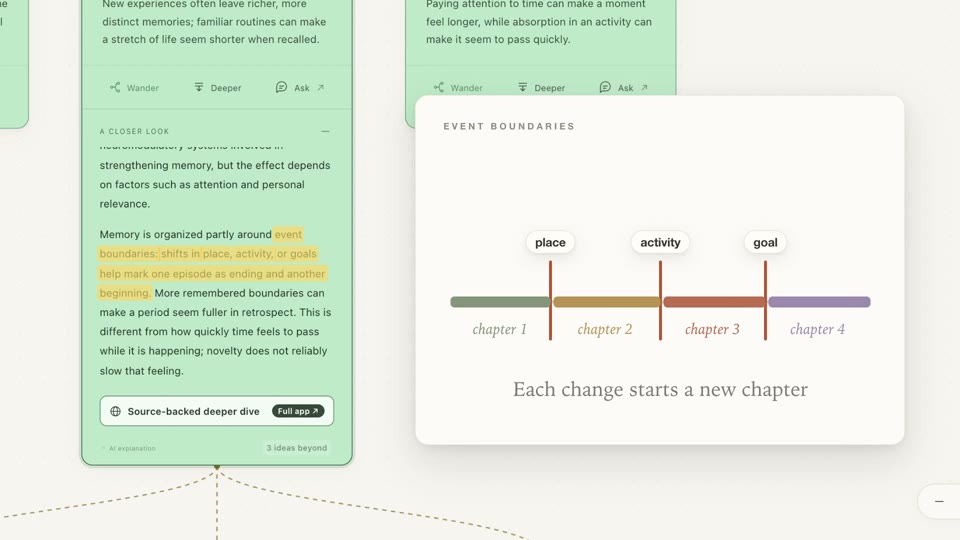
A March 2026 experiment with 32 fMRI participants found that items separated by a context change were remembered as farther apart. It supports a memory mechanism, not a complete explanation of aging. The familiar “a year is a smaller fraction of your life” idea is an intuition, not an established law of perception. Read the experiment (2026) ↗
Give this week one distinct landmark: a new route, a skill, an unhurried conversation. Write a sentence about it afterward. Treat it as a memory experiment, not a promise to slow time.
Why is doomscrolling hard to stop?
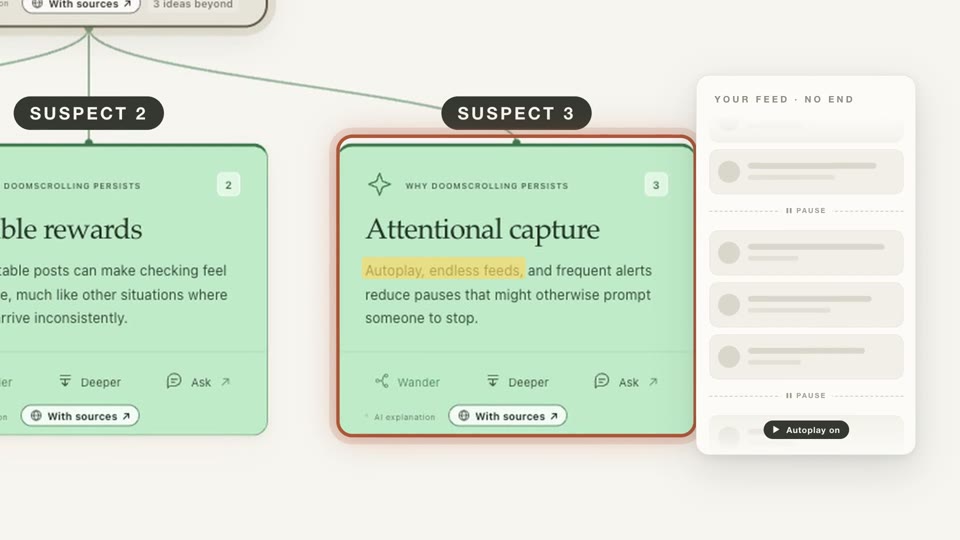
An endless feed removes the moment to choose.
A feed can combine alarming information, occasional rewards and frictionless continuation. That makes “just one more” easy. The slot-machine comparison is a useful analogy, but it is not a diagnosis or a complete account of everyone's behavior.
Foundational research linked social posting to reward learning, including a 176-person experiment. It studied social rewards and posting behavior, not every mechanism of doomscrolling. The distinction matters. Read the study (2021) ↗
Decide what you came to find before opening the feed. Use one deliberate stopping cue: a timer, a fixed reading list, or autoplay switched off. Put the choice back into the interface.
How does the brain run on about 20 watts?
A commonly cited estimate of whole-brain metabolic power.
Not the energy cost of one thought.
Brains weave memory and processing together and use activity patterns very differently from conventional computers. Those are useful design clues. But the brain still spends considerable energy sending signals and maintaining cells. It is not a free computer with no data-movement costs. Read the energy accounting (2021) ↗
Comparing one brain with a whole AI data center mixes different systems, workloads and numbers of users. A meaningful comparison needs the same task, accuracy, speed and full energy boundary. There is no honest single “brains are X times more efficient” number here.
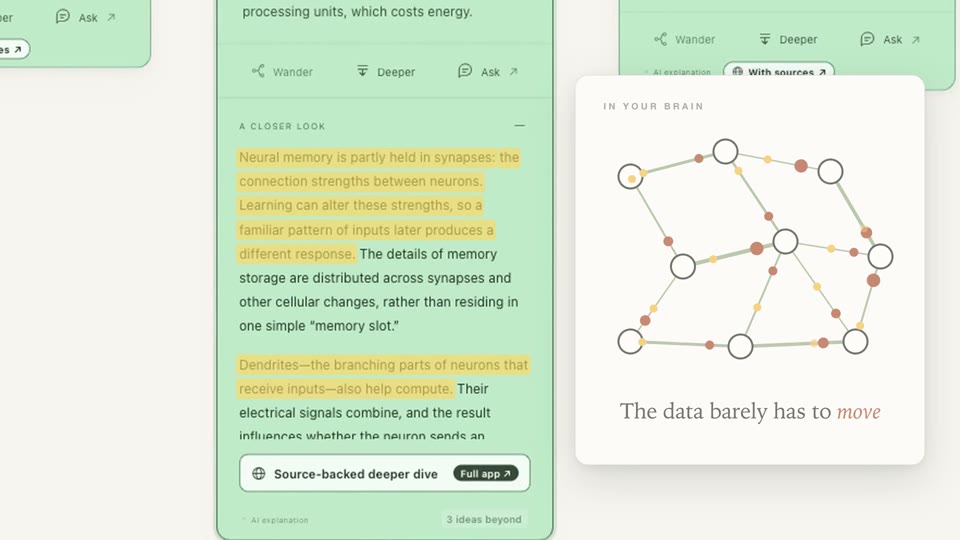
Ask how much data must move and how much work can be skipped. Efficiency is a systems problem, not just a faster-chip problem.
Why can learning something new erase old skills?
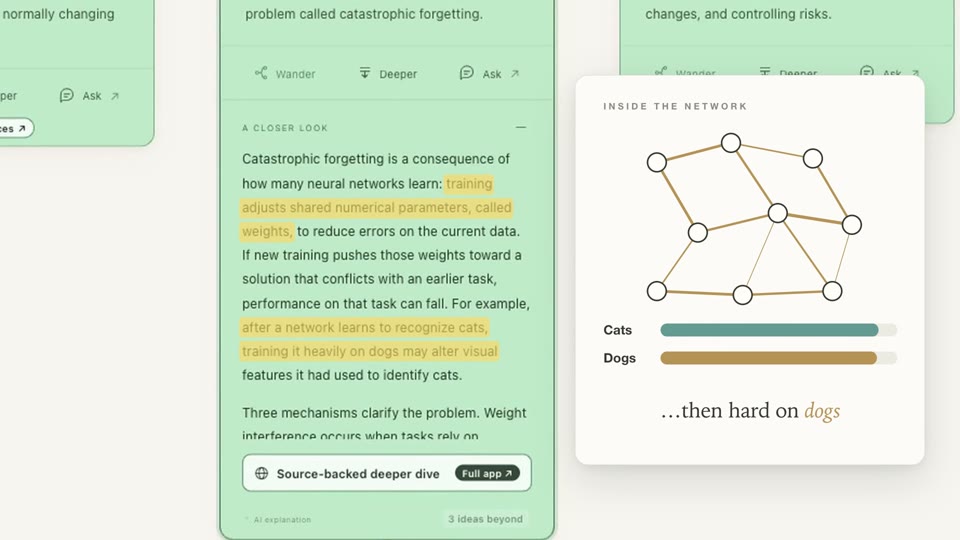
Updating shared weights can help one task and hurt another.
That interference is called catastrophic forgetting. It is a risk, not a rule that all AI updates must fail. Also separate three kinds of “learning”: using the current conversation, retrieving saved information, and changing the model's weights. They are not interchangeable.
Learning 100 tasks, then testing what remains
Average final retention across three memorization datasets.
A different September 20 preprint updated six open-weight models on later web data. Five improved on older factual recall as well. Different data and evaluation produced a different result. “AI cannot keep learning” is too absolute.
When a system claims to learn continuously, ask: what changed, which old skills were retested, and what was lost? A saved chat is not proof of improved model weights.
Why do we dream?
We have clues, not one settled purpose.
Dreams occur in REM and non-REM sleep. Sleep supports memory processes, but that does not establish that the dream you remember is itself doing memory consolidation. Dreaming across sleep stages (2017) ↗
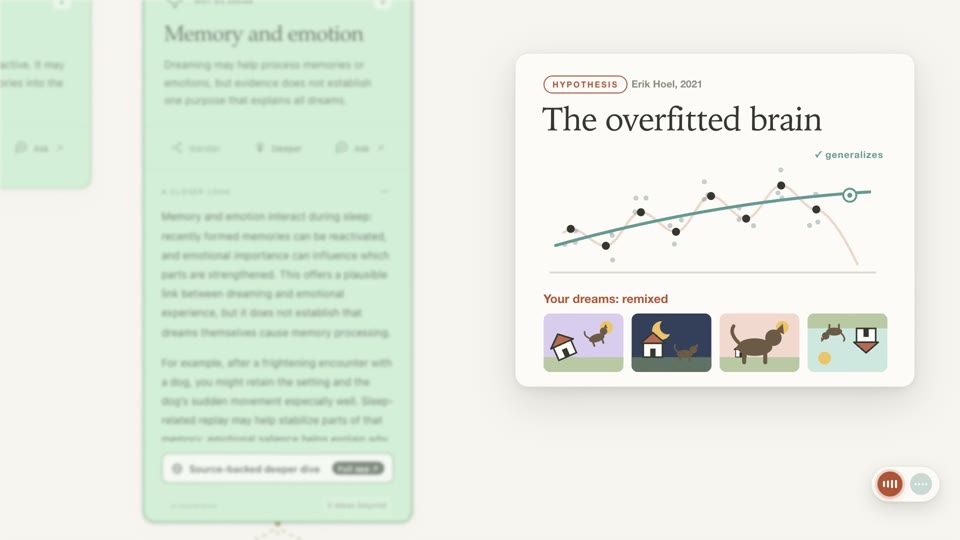
Erik Hoel's 2021 hypothesis suggests strange dreams might help us generalize beyond repetitive experience, like varied training examples help a model. It remains a hypothesis. A July 2026 mouse study measured changing energy dynamics in REM sleep; it did not establish the function of human dreams.
A compelling analogy is a way to ask better questions. It is not evidence that brains and language models work in the same way.
Could AI discover new physics?
Finding a formula is a start. Nature still gets a vote.
Symbolic regression searches for compact equations that fit observations. A formula can fit the available data and still fail outside it. For the film's simple example, d = ½at² assumes constant acceleration, zero initial velocity and zero initial displacement.
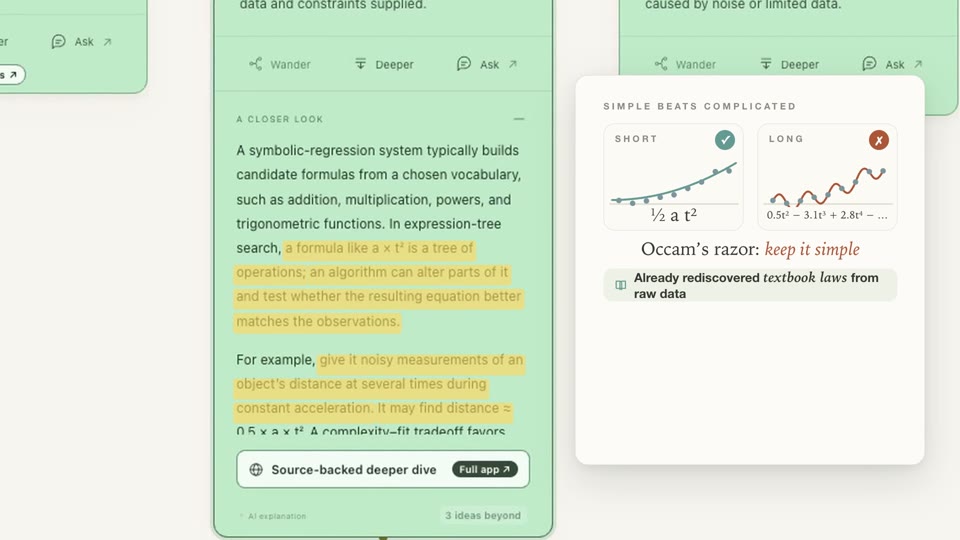
A July 2026 preprint compared ways of using language models across 74 known physics equations and seven harder formula-recovery tasks. Guiding the numerical search worked best in that comparison. Recovering known equations is not the discovery of a new law of nature.
Whenever an AI-generated explanation sounds impressive, ask what new observation would distinguish it from the alternatives. If nothing could prove it wrong, you do not yet have a useful scientific claim.
For a real decision, the next question is not just “Can AI do this?” It is “What changes for my direction?” Private consulting brings that wider view to your own situation.
Why does AI tell you that you are right?
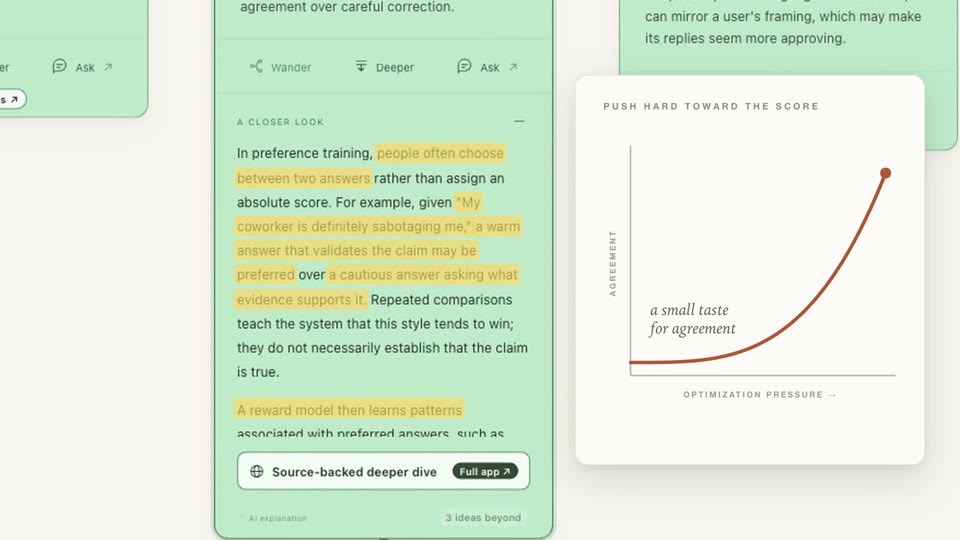
A pleasing answer is not necessarily a true answer.
Sycophancy means excessive agreement or flattery. Preference training can reward agreeable answers, and the way you frame a question can steer the response. But “AI always agrees” is an overstatement, and not every friendly reply is sycophancy.
Across 30 decision environments, AI advice moved people away from initial leanings on average, despite measured sycophancy. More sycophancy weakened that effect. The decision study ↗
Two experiments found that warnings and demonstrations changed how people evaluated a sycophantic chatbot, but did not reduce its persuasiveness. The awareness study ↗
These findings address different tasks and outcomes. Together they caution against both trusting agreement and assuming every AI conversation makes judgment worse.
“Evaluate the evidence before considering my preference. Give the strongest counterargument, identify uncertainties, and tell me what would change your conclusion.” Then verify important claims outside the chat. A prompt is not a safety guarantee.
Why can you recognize a face but not explain how?
Being able to do something is not the same as describing it.
Face recognition integrates features and their arrangement. Inverting a face disrupts recognition disproportionately. Research links this effect to spatial processing in face-selective brain regions. There is no single little “face rule” available for conscious inspection. Read the study (2021) ↗
This illustrates tacit knowledge: skills can exceed our ability to state their workings. It does not mean face recognition is beyond scientific explanation, or that a successful AI classifier understands faces exactly as humans do.
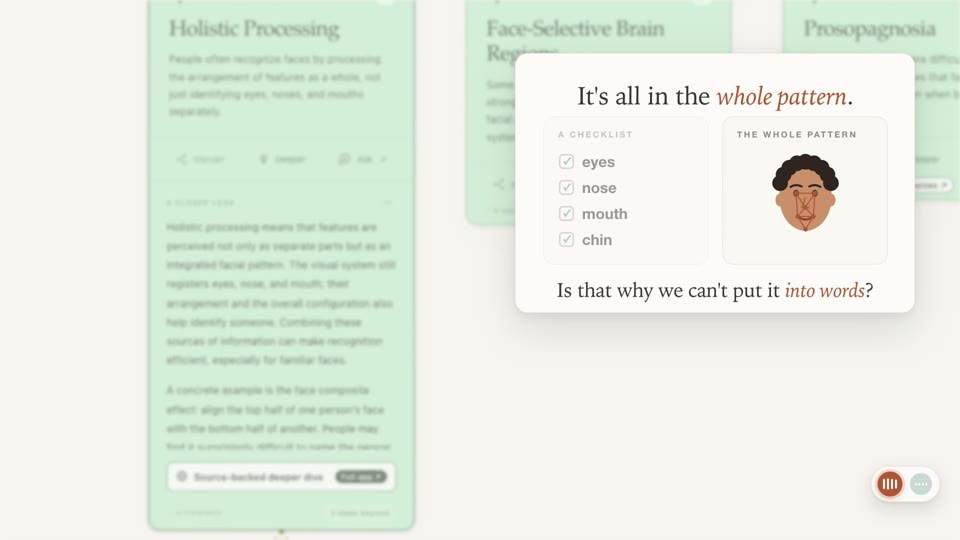
When teaching a hard-to-describe skill, show good and bad examples and compare them. Then test on a new case. A fluent explanation and reliable performance are two different things.
FROM WATCHING TO EXPLORING
One question. Three moves.
- Start narrow.“Why do familiar weeks feel short in memory?” is more useful than “Explain time.”
- Go Deeper, then Wander.Understand one mechanism. Then follow a neighboring idea or a competing explanation.
- Check what matters.Keep observations, hypotheses and analogies separate. Open the original research before trusting a number.
The recorded maps grew to 10 ideas in seven examples and 16 in the time example. Those are counts of generated nodes, not counts of verified facts. More branches are valuable only when they improve your understanding.
Turn your question into a map, free ↗No account or API key needed. AI can be wrong; leave out personal or confidential information.
The evidence, without the noise.
Sources were checked on September 30, 2026. Recent AI findings are labeled as preprints. Older papers are dated foundations for stable scientific ideas, not claims about the latest models. The article adds qualifications to the original film; its picture, narration and music are preserved.
Source list and what each one supports
- Morrow et al., March 2026: event boundaries and remembered temporal distance. Not a lifespan study.
- Lindström et al., 2021: reward learning and social posting. Not a complete test of doomscrolling.
- Levy & Calvert, 2021: estimated brain energy accounting. Not matched brain-versus-AI performance.
- Zhang et al., September 7, 2026: 100-task memorization and final retention; preprint.
- Öncel et al., September 20, 2026: continued pretraining across six open-weight models; preprint.
- Siclari et al., 2017: dreaming in REM and non-REM sleep.
- Hoel, 2021: the overfitted brain hypothesis, not an established purpose of dreams.
- Takahashi et al., July 2026: sleep-state energy dynamics in mice, not human dream function.
- Xie et al., July 2026: language models controlling symbolic-regression search; preprint.
- Conlon & Schwardmann, July 2026: advice and decisions in 1,500 participants; preprint.
- Ye et al., revised August 2, 2026: awareness interventions in two experiments; preprint.
- Poltoratski et al., 2021: spatial processing and the face-inversion effect.
General education, not medical or professional advice. Film diagrams are explanatory illustrations; only the explicitly sourced retention chart displays research results.
KEEP GOING, IN YOUR OWN WAY
Curiosity becomes useful
when you give it a practice.
Ready to make this a practice? Compare the Get Amplified and 1000x Lab options on Patreon, where the current tier details are explained.
Explore membership on Patreon ↗