



FIELD NOTE · FROM IMAGINATION TO ACTION
The ideas you
stopped imagining.
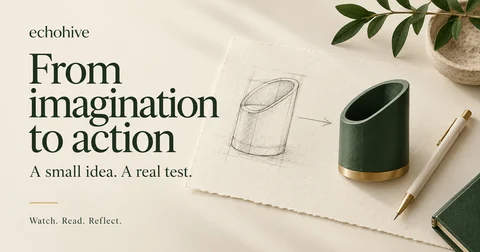
Every tool has widened what one person can carry out. AI connected to tools may bring some shelved ideas back into practical range. Here is a five-step way to test one this week, with your judgment still in charge.
Within Reach
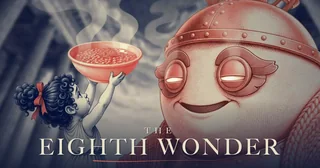
A narration-only film about hands, tools and the ideas we set down before saying them out loud. Made with Claude Opus 5.5, with every image drawn by code, and narrated in the creator’s approved synthesized voice. The companion below adds sources, limits and a worksheet you can use this week.
CHOOSE A MOMENT · TAP TO WATCH
Kinds of claim in this section: MetaphorResearch
A thought needs a way out.
A thought can’t lift a cup or open a door. For most of history, its way out has been the hand. The film goes further: hands may also help shape the thoughts they carry. The evidence for that is real but narrow.
In a 2008 study by Cook, Mitchell and Goldin-Meadow, third- and fourth-graders learned problems like 4 + 3 + 6 = __ + 6 and were randomly told to speak, to gesture, or both. Right after the lesson, the groups performed about equally. Four weeks later, children in the two gesture conditions had retained about 85% of their post-lesson gains, on average; children told to speak without gesturing had retained about 33%. One study, one concept, one age range.
Tools pushed the hand further. The team that found stone artifacts at Lomekwi 3, in Kenya, dates them to about 3.3 million years ago, though other researchers have questioned whether the artifacts really lie in the dated layers. A sharp edge let a hand cut what fingers could not. A needle, a lever, a pen, a printing press, a line of code: each widened the circle of what one person could carry out.
Kinds of claim in this section: Metaphor
The mind learns where the edge is.
Picture that circle around yourself. Inside are the things you know you can do. Outside are the things you can only imagine. The film’s quiet observation is that imagination adapts to the edge: ideas that need skills we lack, time we can’t find or a team we’ll never hire rarely finish forming.
No study is claimed here; it’s a reflection. But it has a practical consequence. When the circle widens, the drawer of shelved ideas doesn’t reopen by itself. You have to look.
Kinds of claim in this section: Research
The model writes. Connected software acts.
Language models let you describe an idea in ordinary words and get back drafts, plans and code. It helps to be precise about what happens next. On its own, a model produces text. It reaches the world only through the tools and access people connect to it: a code runner, a spreadsheet, a calendar, a browser.
- YOUDescribe what you want in plain words.
- THE MODELReplies with text, or a structured request to use a tool.
- SOFTWARE PEOPLE SET UPCarries out the request, with only the access it was given.
- YOU, AGAINCheck the result before it counts.
What you connect is what it can touch. Choosing the tools, the data and the steps that wait for your approval is where your judgment enters the system.
Kinds of claim in this section: Illustration
Small ideas that used to need a team.
The film reopens three drawers. All three are fictional illustrations, not case studies or measured gains. Look at what stays with the person in each.
A fractions game for one class
- The new passage
- The teacher describes it and a model writes a simple web page. The teacher tries it with a few students and says what feels wrong.
- Still yours
- Deciding what good teaching looks like.
A box of family recipes
- The new passage
- Photograph the cards. A model that can read the photos turns them into a searchable book the whole family can use.
- Still yours
- An afternoon checking every line against the cards, because a misread teaspoon can quietly become a tablespoon.
A year of scattered health notes
- The new passage
- A model helps turn the notes into a simple chart.
- Still yours
- Bringing it to your doctor so the two of you can look at it together. A chart starts a conversation. It isn’t a diagnosis.
The film is a fourth example. Every image in it is drawn by code written with an AI model, and none of it existed until that code was run and checked. Those production checks were automated and sampled, not a frame-by-frame human viewing.
Kinds of claim in this section: ResearchOpinion
Feeling fast is a poor instrument.
A new reach takes getting used to, and our instincts about it can be wrong. In a randomized study METR published in July 2025, 16 experienced open-source developers worked on 246 real issues in mature projects they knew well. Each issue was randomly assigned to allow or disallow the AI tools of early 2025.
A February 2026 update with newer tools found signs of a speedup, but the researchers called that data unreliable, citing who chose to take part and how time was measured. So this is evidence neither that today’s tools are slow nor that they are fast.
What survives is narrower and more useful: the feeling of speed is not a measurement. That’s why step three below asks how you’ll know it worked before you begin.
Kinds of claim in this section: Practice
Five steps for one small idea.
A suggested practice from the film, not a validated method. The fields are optional: use them as a scratchpad, or copy the prompts onto paper. This page doesn’t save or send anything you type, so copy what you want to keep.
See it filled in: the teacher’s fractions game (fictional)
Drawer: a fractions game for my class · a reading log students keep themselves · a quiz built from last year’s mistakes
Project: one web page with ten “which slice is bigger?” questions
For: six students in my class who mix up comparing fractions
It should: show two pizzas, take an answer, then show why with the slices side by side
It worked if: the six finish without my help and can each explain one answer aloud
Use only: a model to write one web page I open on classroom laptops; no student names or data
Ask me before: anything students will see, and any change to the questions
First real test: Tuesday’s small group, noting where each student hesitates
-
Open the drawer
Write down three things you stopped imagining because they seemed out of reach. Don’t judge them yet.
-
Shrink one
Pick one and cut it to the smallest version you could test this week. If it can’t meet a real person within seven days, shrink it again.
-
Say it plainly
Who it’s for, what it should do, and how you’ll know it worked. Decide the last one now, before the feeling of progress can stand in for it.
-
Keep your hand on it
Give it a passage, but connect only the tools and data it needs. Decide which steps wait for your yes, such as sending, deleting, spending, publishing or sharing anything personal. Think twice before giving any service health details or other people’s names.
-
Test it against the world
Real data and real people, not just your hopes. A version that only works on your own example hasn’t met the world yet.
Then redraw your circle. What moved? What is still out of reach, or turned out not worth reaching for?
Your plain brief
Paste it into the AI tool you use, or hand it to a person who is helping. It stays on this page until you copy it; any service you paste it into has its own data policy.
Kinds of claim in this section: Opinion
A wider reach doesn’t decide for you.
Some things that come within reach still shouldn’t be done, and some should be done slowly. A wider reach only makes our choices travel farther. A misread recipe stays in one kitchen. A tool connected to a calendar, an inbox or a shared folder can carry the same kind of mistake to other people.
So the judgment, the testing and the responsibility stay where they’ve always been: with the person who reaches.
Sources, dates and boundaries.
This is a reading companion to the narration-only film Within Reach, not a transcript of it. It relies on the film’s evidence ledger, whose source checks are dated October 2 and 3, 2026, and adds no new research. The teacher, recipe and health examples are fictional. The five steps are a suggested practice, not a tested method.
Open the seven sources
- Cook, Mitchell and Goldin-Meadow, Gesturing makes learning last. Cognition 106(2), 2008 (doi). One study, grades 3 and 4, one math concept. Gestures were taught by the experimenter, and the effect concerns retention four weeks later.
- Harmand et al., 3.3-million-year-old stone tools from Lomekwi 3, West Turkana, Kenya. Nature 521, 2015. The discovering team’s date and interpretation. Who made the tools is not established.
- Domínguez-Rodrigo and Alcalá, a 2016 critique in PaleoAnthropology questioning whether the Lomekwi artifacts lie in the dated layers. Listed as a pointer to the debate.
- METR, Measuring the Impact of Early-2025 AI on Experienced Open-Source Developer Productivity. July 10, 2025. A historical randomized study in one setting, not a verdict on all tasks or tools.
- METR, update on the developer study with newer tools. February 24, 2026. The researchers consider the new data unreliable. Not an estimate of current capability.
- Anthropic, Tool use with Claude. Vendor documentation: the model returns a structured tool call, and the developer’s application, or Anthropic for server tools, runs it.
- Yao et al., ReAct: Synergizing Reasoning and Acting in Language Models. 2022. Describes models emitting actions that an external interface executes. Its benchmark results are not evidence of real-world reliability.
Read the exact narration
The film’s narration as spoken, with its original punctuation. Numbers are written the way they are said.
A thought, on its own, can't move anything. It can't lift a cup, open a door, or write its own name. For that, it needs a way out of the head, and for most of our history, that way out has been the hand. And hands don't only carry our thoughts out into the world; they help shape them. In one study, children asked to gesture while learning a new kind of math problem held on to it better, weeks later, than children asked only to speak.
Then hands began picking things up, and making them part of their reach. Stone tools found at Lomekwi, in Kenya, are about three point three million years old. A sharp edge let a hand cut what fingers alone could not. Every tool since has done something similar: a needle, a lever, a pen, a printing press, a line of code. Each one widened the circle of things a single person could actually carry out.
Picture that circle around yourself. Inside it are the things you know you can do. Outside it are the things you can only imagine. And here is something quiet about the mind: it learns where that edge is, and starts imagining inside it. Ideas that need skills we don't have, time we can't find, or a team we'll never hire rarely get to finish forming. Maybe it's a game made for one particular class, a box of family recipes, or a year of scattered notes about your health. We set them down before they're even spoken.
Now a new kind of passage is opening. Language models let us describe what we imagine in ordinary words, and get back drafts, plans, and code. But it helps to be precise: on its own, a language model produces text. It reaches the world only through the tools and access people connect to it: a code runner, a spreadsheet, a calendar, a browser. When a model uses a tool, it sends back a structured request, and it's software, set up by people, that carries it out.
If you're exploring this new reach yourself, Get Amplified is my living field guide on Patreon: AI and agents, markets, and the mind. And in the Thousand X Lab, we explore ideas like this live on Sundays, with a replay of every session. It's at echohive dot A I slash get amplified.
So, let's open that drawer again. Take a teacher who wants a fractions game built around one particular class. Before, that would usually have meant finding a programmer. Now the teacher can describe it, have a model write a simple web page, open it, try it with a few students, and say what feels wrong. The model drafts; the teacher still decides what good teaching looks like. Or take that box of family recipes. With a phone camera, a model that can read photographed pages, and an afternoon spent checking every line against the cards, it can become a searchable book the whole family can use. Or that year of scattered health notes, turned into a simple chart to bring to your doctor, so the two of you can look at it together.
Even this film is an example. Every image in it, and the original score composed for it, is code written with an AI model. None of it existed until that code was run, watched, and judged.
But a new reach takes getting used to, and our instincts about it can be wrong. In a randomized study in early twenty twenty-five, sixteen experienced open-source developers expected AI tools to make them faster. Afterward, they believed the tools had sped them up, yet tasks with the tools allowed took about nineteen percent longer. A follow-up with newer tools found signs of a speedup, but the researchers called that new data unreliable. The lesson isn't that these tools are slow, or fast. It's that feeling fast is a poor measuring instrument, and speed, on its own, was never the same as intelligence.
So how do we rediscover what's within reach, and learn to use it well? Here is one practice, in five steps. First, open the drawer: write down three things you stopped imagining because they seemed out of reach. Second, shrink one of them to the smallest version you could test this week. Third, say it plainly: who it's for, what it should do, and how you'll know it worked. Fourth, give it a passage, but keep your hand on it: connect only the tools it needs, and approve the steps that matter. Fifth, test it against the world, with real data and real people, not just your hopes. Then redraw your circle, and notice what has moved.
Some things that come within reach still shouldn't be done, and some should be done slowly. A wider reach doesn't decide anything for us; it only makes our choices travel farther. So the judgment, the testing, and the responsibility stay where they've always been: with the person who reaches.
Our hands taught our minds what was possible. Now our minds have something new to learn. Not to imagine bigger for its own sake, but to notice what has quietly come within reach, and to reach for it with care.
To go further, Get Amplified is my living field guide: practical video lessons and worked examples, from step-by-step AI builds and directing agents, to understanding markets and exploring the mind. The Thousand X Lab is where we explore live, on Sundays: current ideas, open discussion, and your questions, with replays if you miss one. Architect membership includes the Lab, every Get Amplified lesson, and the project code archive. And for one-to-one help with your own project, there's private consulting, a separate, higher tier that includes Architect. Start at echohive dot A I slash get amplified; the Patreon links are in the description. Open the drawer, and keep your hand on what you make.
About the film: its images, and an original score heard only in the music version, were written as code with Claude Opus 5.5. This page plays the narration-only version. The narration uses the creator’s approved synthesized voice. Production checks were automated and sampled. Sources as recorded in the evidence ledger, October 2 to 3, 2026.
OPEN THE DRAWER. KEEP YOUR HAND ON THE WORK.
Reach further.
Choose with care.
Ready to make this a practice? Compare the Get Amplified and 1000x Lab options on Patreon, where the current tier details are explained.
Explore membership on Patreon ↗Get Amplified’s markets material is educational analysis, not investment advice. Its attention material is personal exploration, not therapy.